Stop Reporting Yesterday’s Rain: Why Your Status Meetings Are Killing Delivery
A 15‑minute Daily Scrum isn’t a meeting. It’s a weather forecast for your delivery engine.
I’ve sat in over 500 status meetings. Banking. Retail. Tech. Same script every time.
Someone opens a slide deck. Fourteen people watch a spreadsheet scroll. The presenter says, “As you can see from last week’s data…” Forty‑five minutes later, the team has:
- Reviewed what already happened
- Argued for twenty minutes about a problem that already derailed a sprint
- Agreed to “take it offline”
Here’s the brutal truth: that meeting was obsolete before it started. By the time you present a status update, the information is already old. You’re not managing risk. You’re writing a eulogy for time you can’t get back.
Most Agile advocates get this wrong too. They’ll tell you to replace the 90‑minute status meeting with a 15‑minute Daily Scrum. Then they defend it as “not a meeting” while looking guilty about the calendar invite.
Stop defending. Start reframing.
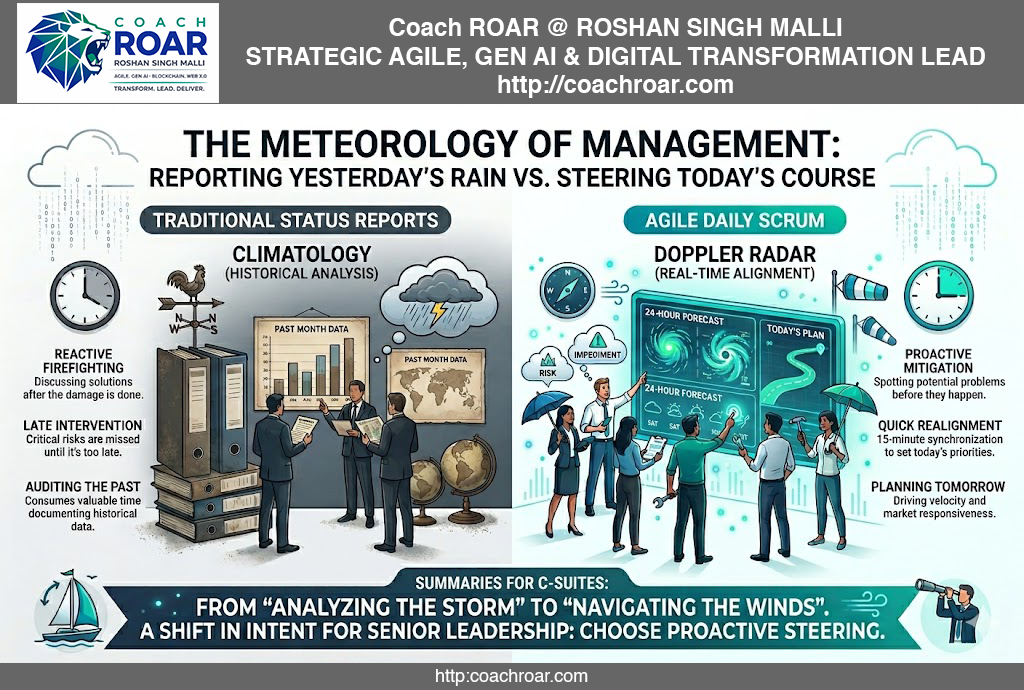
Think Like a Meteorologist, Not a Historian
You’re a pilot halfway across the Atlantic. You ask for a weather update. Your co‑pilot pulls out a printout from three days ago and says:
“Well, last Tuesday it was sunny over Greenland. Then there was a storm. We discussed it for an hour. No one knew what to do. So we wrote a risk log.”
Ridiculous, right? You’d fire her mid‑flight.
That’s exactly how traditional status meetings work.
Traditional status meetings = historical climate report.
They tell you what the storm did yesterday. Useful for archivists. Useless for keeping your project dry today.
The Daily Scrum = live Doppler radar.
Fifteen minutes to scan the horizon for what might hit you in the next 24 hours. Then adjust your course before the storm arrives.
That’s the shift executives actually understand. Not “ceremonies.” Not “Scrum guidelines.”
Radar vs rearview mirror.
The Three People in Every Room (And What They Actually Want)
The Traditional Project Manager
20 years, PMP, loves a RAID log
What they say: “Without a status meeting, how do I report to the steering committee? ‘We talked for 15 minutes’ isn’t a progress update.”
What they actually mean: “I need something to put in my deck so my stakeholders don’t eat me alive.”
Give them a lightweight, automated weekly digest. A one‑page outcome summary. Don’t force them to choose between Agile and their bonus.
The Agile Coach
Certified, passionate, sometimes insufferable
What they say: “You’re missing the point! The Daily Scrum is for the team, not for management. If leaders attend, the team won’t speak honestly.”
What they actually mean: “Stop hijacking the team’s safety zone for your command‑and‑control reporting.”
They’re right, but they’re also naive. Leaders won’t just disappear because you quote the Scrum Guide.
The C‑Suite Executive
The one signing your transformation checks
What they say: “I don’t care how you meet. I care whether you deliver. Can you prove this prevents fires or just creates more talk?”
What they actually mean: “Show me the ROI of those 15 minutes, or I’m cutting it.”*
Here’s the answer that works:
“A Daily Scrum surfaced a dependency on Tuesday morning that would have cost us four days if discovered on Friday. That’s 80 hours of team time saved for 15 minutes of sync. The ROI is 320x. What else in your portfolio delivers that?”
The 15‑Minute Script That Actually Works
Forget “What did you do yesterday?” That’s history. You’re not a historian.
Use the weather script instead:
- Forecast (intent) – “Today I will complete the API integration to unblock the checkout flow.”
- Radar (risks) – “I see a 30% chance of delay because the vendor hasn’t confirmed their endpoint.”
- Barometer (help needed) – “I need someone to escalate to the vendor by 11 AM or I’m stuck until tomorrow.”
Fifteen seconds per person. Three questions that point forward.
And here’s the discipline that separates pros from amateurs: the moment someone says “we need to discuss this” – stop them.
The Daily Scrum is where problems get named, not solved.
The solving happens after, with exactly the three people who can actually fix it. Not the whole room. Not the whole department. Just the right people, just in time.
The Real Cost of Getting This Wrong
Let’s do the math your CFO will appreciate.
A 90‑minute status meeting with 10 people = 15 hours of organizational time.
A Daily Scrum with the same 10 people = 2.5 hours per week.
The difference? 12.5 hours saved weekly. Per team.
Multiply by 10 teams: 125 hours weekly. Over 6,000 hours annually.
That’s three fully loaded salaries worth of time you’re currently spending discussing things that already happened.
The question isn’t whether the Daily Scrum is worth 15 minutes.
The question is whether your organization can afford to keep meeting about yesterday’s rain while tomorrow’s storm builds on the radar.
Your Move
Two choices this Monday morning.
Keep the 90‑minute status meeting where everyone stares at a spreadsheet of last week’s delays.
Or try fifteen minutes of radar. Fifteen minutes of forward intent. Fifteen minutes to launch the day instead of reviewing the past.
The weather’s changing either way. The only question is whether you’ll see the storm coming or just feel the rain.
What’s the biggest meeting waste you’ve seen?
Comment RAIN if you’ve survived a 2‑hour project update.
Comment RADAR if you’ve seen a Daily Scrum catch a real blocker.
I hoped I shared a narrative that changes minds. Not “Agile is better.” Not “Scrum says so.”
Just: “Do you want to see the storm coming, or just feel the rain?”

Leave a Reply
You must be logged in to post a comment.